
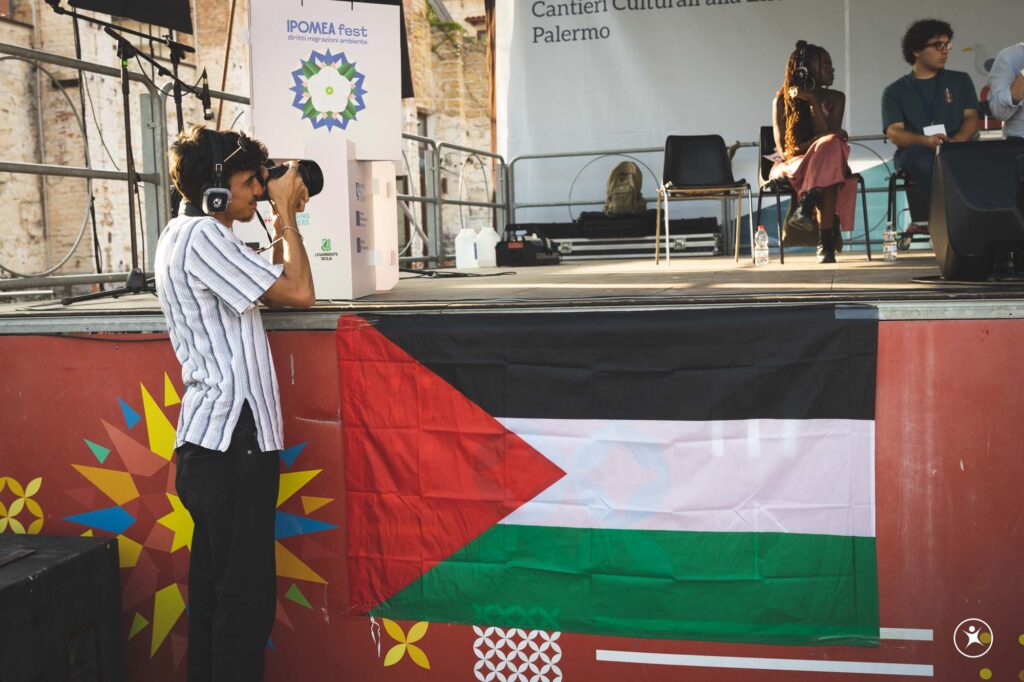
“In a context of censorship, like in the West Bank, the camera becomes a weapon.’
With these words, Yazan, a 24-year-old Palestinian filmmaker, describes his mission to bring to the world the stories of people fighting for their identity and freedom, who refuse to surrender to repression. In a country marked by conflict and suffering, Yazan reminds us not to be consumed by dark moments but to always look for the light at the end of the tunnel.
He has been with us for a few months now, thanks to the ESC program, which allowed him and two other Palestinian youth to make a long journey from Bethlehem, Ramallah, and Nablus to Palermo. Here, they have challenged themselves as volunteers, gradually discovering the local associative realities.
What’s going on in the West Bank as we’re speaking?
The general situation in Bethlehem is getting worse , the day I left to come to Palermo they [Israeli Defence Forces, from here on IDF] were putting up gates between cities and villages, they were arresting more and more people.
The situation regarding check points is getting harder, settlers are taking more and more land, taking over even houses and schools.
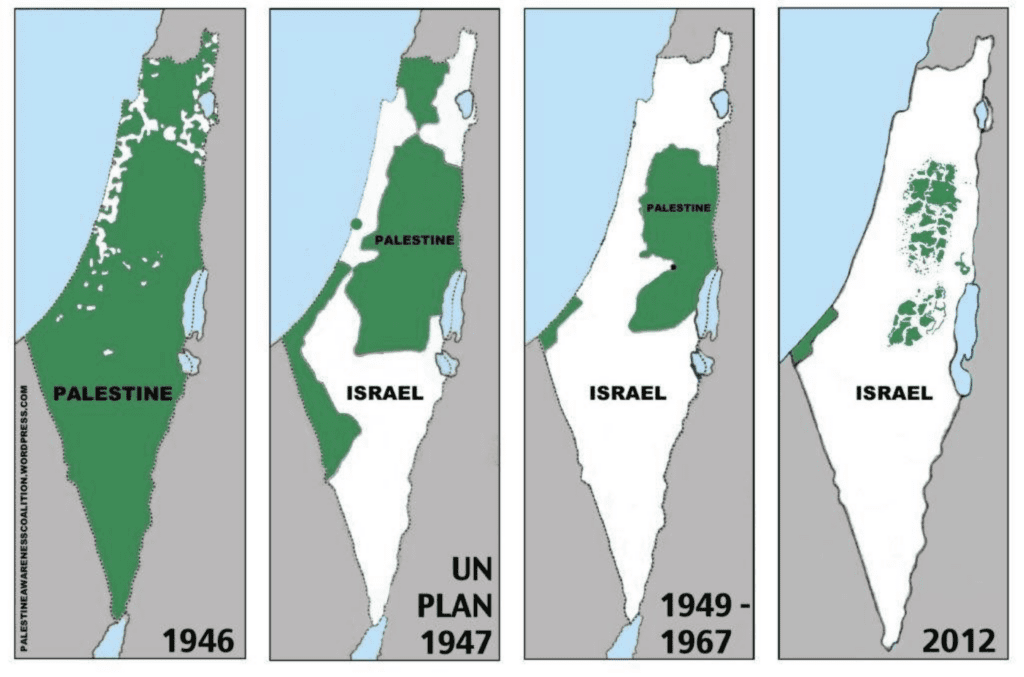
Can you tell me how the Palestinian territory has changed over the years, since 1948?
Since 1948, the Palestinian people have lived through a series of events that have shaped their history. The Nakba, or “Catastrophe,” was one of the most painful and significant episodes, during which hundreds of Palestinian villages were destroyed, and thousands of people were forced to leave their homes. Most of them sought refuge in neighboring countries, such as Lebanon, Egypt, Jordan, and Syria. Others ended up in refugee camps, where their condition of exile became one of the most persistent and tragic realities.
This painful diaspora continued to mark the history of Palestine, but the occupation of its territory took a new turn during the Six-Day War of 1967. During this conflict, Israel conquered much of the Palestinian territories, including the West Bank and Gaza. By the end of the conflict, Palestine was further fragmented, with growing militarization of its lands and a new reality of oppression for its people.
In 1993, the Oslo Accords marked a turning point, but the Palestinian territory was divided into three areas with different levels of control. Major cities such as Ramallah and Nablus (Area A) remained under Palestinian control, but were under strict Israeli surveillance. Surrounding cities (Area B) were administered by the Palestinians, but security was in Israeli hands, with frequent military interventions. Finally, Area C, which comprises over 60% of the West Bank, remained completely under Israeli control, with the construction of settlements and heavy restrictions imposed on the Palestinian population.
How did it change since 7th October 2023?
After the 7th of October it has of course worsened. I talk about it in my first documentary “Settlers violence: Accounts from Bethlehem” , they [IDF] disrespect every human right, just because they feel entitled to. They start by claiming a small portion of land, then they expand more and more until they get recognised by the Israeli government, which authorises their occupation.
What is the purpose of your filming activity?
I use the power of film to bring silent voices to the world. I have a big tool which is the camera. My first documentary was about the people that were affected by the settlers violence. I did about 4/5 interviews discovering in each place a different story. I went to Tqou’ – Khalayil Al-Lawz – Al-Makhrour Valley. This idea was suggested by Balasan: Initiative for Human Rights Organization.
In the stories I encountered, some people were affected with direct violence, being shot at for example or beaten. My films are about showing the world that there are still people who resist despite the violence from Israeli settlers.
I film firstly for myself, then if I find what I filmed worth telling, I show it to the rest of the world, to make the unheard voices of Palestinians heard.
What type of resistance, if you found any, did you run into when filming?
Filming in the West Bank is very tough, the camera becomes a weapon, because they don’t want the world or even themselves to see, they want to focus on the beauty of their big cities like Tel Aviv, the beautiful beaches and skyscrapers and ignore what really goes on “behind the scenes”.
Have you ever been personally targeted by this?
My university is bordered by the Apartheid wall. One time, as I took out the camera, the IDF seized it and threatened to break it, even though I wasn’t filming at that moment.
Another difficult moment was filming the check point, my father was very scared when he was recording some footage that made it into my second documentary “The Unwanted Path”.
Can you not film the check point? How so?
Because they [IDF] humiliate you in every way while at the checkpoint, they point guns at you,make you wait for hours, make fun of you. They also don’t want you to show the world their corrupt system.
What do you mean by corrupt?
One time I was passing the check point coming home from university, I was stopped and the soldier started checking my documents. As i thought i was ready to go, i was asked to step out of the car, as i stepped out I accidentally dropped my headphones and they fell on the ground. At that moment, I could not just lean down and pick them up because he had his gun pointing at me, he told me to get back into my car and just try to reach them from the car window. This is the kind of humiliation I was talking about. He enjoyed seeing me struggle and so I kept trying to laugh about it, because I knew it would make him mad. After 10 to 15 minutes I managed to reach my headphones and pass the check point, he started making jokes saying things like “Drive safe” or “Have a good night” like nothing ever happened.
In what way does “The Unwanted Path” show the socio-economical situation in the West Bank?
I started filming the second documentary in 2021-2022, at the time the economical situation wasn’t great, but it was manageable. At the time, if we wanted to, we could travel to Israel to work, because it was the only way to earn some money. You see, for the same job you are paid 70 shekels (17/18 euro) in the West Bank and 350 shekels (89/90 euro monthly) in Occupied Palestine.
So, even though most times the work situation had its challenges and wasn’t safe, as I show in the documentary. Workers still preferred to move even for months at a time (if they were given the permits) to earn some money they could bring back home.
The opportunity was there. Now it’s not possible, they blocked work permits, the political and the economical situation got worse as the tension is growing. So many people depended on the work in Israel, and it was the same way around, because they now have lost the labor force.
After the 7th of October they [Israel] tried replacing Palestinian workers with Indian or Russian workers but they didn’t do the same amount of work and didn’t bring as much income as Palestinians did.
Apart from your filming activity, have you ever participated in other projects ?
I followed a lot of personal projects. I collaborated with “Sounds of places” project, an urban project that explores the sounds of Al-Makhour valley, which the settlers are trying to take.
As Palestinians we are resisting non-violently by putting camp sites there. I’m not aware of the situation now, but before I left it was ongoing. The settlers want to take that land because it’s the only green area left near my village. The project is based on focusing on the sounds of nature, resembling the reality of a settlers-free Palestine.
Another personal project was about a strike: when there’s a martyr in our city that was killed by Israeli violence, we carry it across the streets. Towards the end of it, we went to the Apartheid wall and soldiers started attacking us, throwing rubber bullets and tear gas from every direction. That project was the most engaging for me. I kept filming even when the situation was getting more and more heated. That for me was so powerful, staying and filming, I risked everything to capture those images, and to make sure they got to the outside world.
What is the message that you’re trying to send with your latest documentary “The Unwanted Path”?
No matter how tough things will be, as Palestinians we will still find a way to resist, we thrive in the hardest situations, we live with it and we reflect upon it in our own way.
Yes, my dads work is very tough and dangerous, but from his point of view, as I tried to depict in the documentary, he still has a life, family, friends, free time, and happiness.
There will always be light and joy inside of us no matter how hard life gets.